“gardening, more than architecture, more than painting, more than music, and far more than literature, is an ephemeral art; its masterpieces disappear leaving little trace.” History of Garden Design

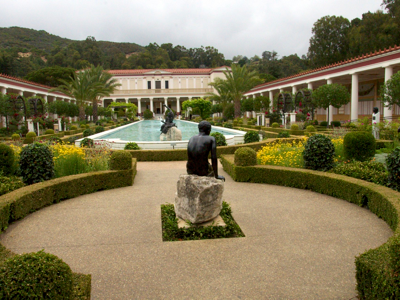
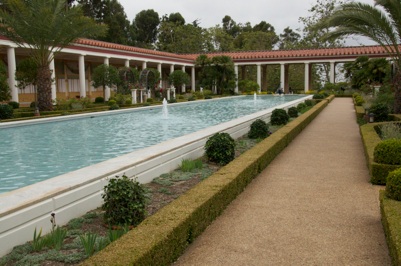
Getty Villa, Pacific Palisades, CA
Garden history rarely makes it into schoolbooks even though it tells a rich and colorful story of cultural progress. Throughout time people seek food, health, beauty, and pleasure. Gardens don’t exist in cultures that must spend all of their energy to survive. Gardens evolve as citizens have leisure time.
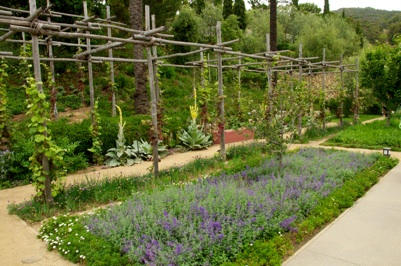
Patrick Bowe, author of Gardens of the Roman World writes, “Our knowledge of Roman gardens is based on four sources: literary testimony, archaeological evidence, pictorial records and horticultural traditions.” Ancient Romans were farmers and the records of Pliny, both the elder and the younger, left extensive written materials about horticulture of the time. The eruption of Mt. Vesuvius in 79 AD preserved the evidence of Roman gardens in daily life. Archeology dig discoveries continue to reveal more information to this day. Wall murals and mosaics found in ruins provide pictorial evidence of plants and garden scenes of the era. What we consider common horticultural practices of raised beds, pots, trellis and cisterns are found in ancient Roman gardens.
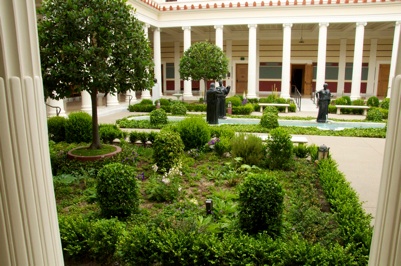
The Getty Villa in Pacific Palisades, CA recreates an Italian Villa engulfed by Vesuvius, the Villa de Papyri, owned by Julius Caesar’s father in law. Built to display J.P. Getty’s collection of Greek, Roman & Etruscan antiquities, the garden is an integral part of the villa. While it might be a fascinating adventure to tour the ruins of Herculaneum & Pompeii, it is no less fascinating to visit the Getty Villa to see garden ideas from the Roman Empire as relevant today as they were then.
Most visitors come to see the collections inside rather than the gardens. Yet the gardens are a dazzling display of life in a villa during the height of Roman gardening. The gardens tour by Villa docents gives a greater understanding of the importance of gardens in ancient times.
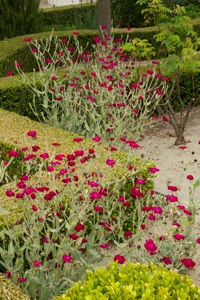
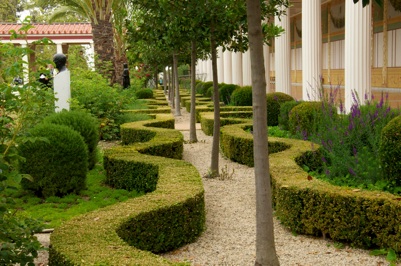
Walking through the main living space of the Villa you enter into the central courtyard, a cool and colorful garden space designed for socializing, pleasure, and outdoor dining. A central water feature is more than a visual treat; it is functional too - placed so plants can easily be watered. The symmetry of Italian architecture is seen in the formal garden as plantings on one side of the garden are repeated on the other. The wings of the house surround the inner peristyle or covered walkway.
Originally published in Roots & Shoots, Maricopa County Master Gardener Newsletter. http://cals.arizona.edu/maricopa/garden/mgcentral/uploads/Oct11.pdf
October 3, 2011